Fan service
O fenômeno Jungkook: O sucesso do BTS e a criação de um superstar mundialFan service is a central practice of the K-pop idol system: a set of staged yet often emotionally meaningful interactions designed to make fans feel personally recognized. It helps convert a performer’s public appearance into a continuing relationship, linking concerts, digital platforms, promotional events, and fan-organized activity. For Jungkook, the practice is not confined to formal gestures of affection; it is part of the larger system through which his music, image, and connection with ARMY are continually produced and renewed.
Definition and Industrial Function
Fan service includes the deliberate cultivation of closeness between idols and audiences. At fansigns, fans who purchase enough albums receive lottery tickets for private events where idols sign albums, talk with attendees, perform song covers or comic sketches, and fulfill small requests such as wearing cat ears, holding hands, or maintaining eye contact. Jungkook appears in recordings from these encounters briefly taking a fan’s hand and interlacing their fingers, or wearing a fluffy Cinnamoroll hood and shaking his head so that its ears move. Such gestures are small in duration but large in symbolic effect: they make a mass-market relationship feel individualized.
The practice became even more important as entertainment companies developed digital channels that could extend intimacy beyond the concert venue. Idols spend hours in live broadcasts, and Jungkook is particularly known for appearing spontaneously. At first, BTS broadcasts were supervised by staff members who ensured that everything proceeded smoothly. After the members began living independently, Jungkook increasingly broke that pattern, broadcasting when he chose. On February 1, 2023, he began an improvised live stream and remarked aloud that he was old enough to do so, accompanying the assertion with a mischievous smile. During the COVID-19 pandemic, his Weverse broadcasts became a source of pleasure for many ARMY members isolated at home. In June 2023, he even fell asleep during a broadcast watched by more than six million viewers, who observed him sleep for about forty-five minutes before a staff member ended the stream remotely.
Fan Participation Beyond the Idol’s Gesture
Fan service depends on work performed by fans themselves. Before companies recognized the importance of addressing international audiences, fans translated and subtitled much of the available K-pop content. Big Hit Entertainment did not begin officially subtitling BTS videos until 2019, years after the group had acquired international recognition. The volunteer organization BTS-Trans and its subtitling branch Bangtansubs therefore became an important infrastructure for making BTS content accessible beyond Korean-speaking audiences.
Founded in 2013, the team grew to about thirty members, including translators working across Korean, Japanese, Mandarin, Indonesian, and English, as well as timers, typesetters, video coders, secretaries, coordinators, and administrators. Its members lived in Germany, the Philippines, India, and the United States and ranged from sixteen to thirty-seven years old, with occupations including doctoral student, architect, graphic designer, and high-school student. By the end of 2024, Bangtansubs had 1.46 million YouTube subscribers and more than one thousand subtitled videos. Its most popular video, a BTS reaction to the Bangtan Bomb recording of Blood Sweat & Tears uploaded on October 12, 2016, had reached 9.8 million views.
This labor operated as an organized digital production line rather than casual individual enthusiasm. Team members communicated through Discord, while Trello and a shared Google Drive assigned and tracked tasks. A short video could be completed in a few hours, whereas a difficult episode of Run BTS! might require a team of reviewers and take months or even years. A one-hour-and-eleven-minute broadcast celebrating BTS’s first anniversary required four translators, one timer, two typesetters, and a coder-uploader, with notes and references added to preserve context and convey the original meaning as faithfully as possible.
Other forms of participation perform similar promotional work. Fan edits, memes, illustrated art, and compilation videos reshape hours of footage into easily shareable portraits of an idol’s personality. Fancams isolate an individual performer during a group performance, preserving details such as a wink, a precise movement of the feet or arms, or the changing position of a fringe. Jungkook’s official Boy With Luv fancam from M Countdown in April 2019, showing him in a beige suit and blue floral tie, had more than sixty-two million views; an unofficial fancam of BTS performing Idol at the Lotte Family Concert four months later, with Jungkook in a black suit dancing intensely and throwing his sweat-soaked hair, had more than eighteen million.
Collective Emotion and Streaming Rituals
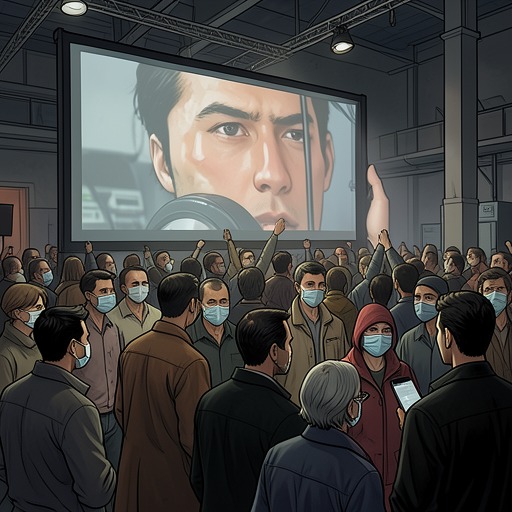
Fan service also operates through collective synchronization. At Jungkook’s GMA Summer Concert performance, a sudden storm warning prevented the planned eight-o’clock show and forced the team to move directly to a soundcheck recording. Fans entered quickly carrying phones and Cooky plush toys, while Jungkook adapted backstage as his stylist replaced his sweatshirt with a white studded Givenchy shirt. Over nine minutes, he performed three songs, including the first live performance of Seven. The song’s video had been released at midnight and had accumulated eighteen million YouTube views by the time of the recording. Supported by a band and four dancers, Jungkook moved lightly while singing in a smooth tenor voice, and the audience answered with raised hands, finger hearts, and repeated chants of his name.
The performance made fan service visible as a shared emotional circuit. During his solo version of Dynamite, Jungkook extended the microphone so the audience could sing with him. The gesture did not merely acknowledge spectators; it temporarily made them part of the performance. The same pattern appeared at BTS’s Chile concerts, where 17,000-capacity Movistar Arena was filled with Army Bombs, the group’s official lightsticks. Fans outside imitated choreography and waved handmade fans bearing their favorite member’s face; inside, the glowing symbols transformed the arena into a coordinated visual field. The audience’s participation gave the concert its reciprocal structure: the performers supplied music and movement, while fans supplied volume, light, rhythm, and visible allegiance.
Streaming campaigns extend this collective ritual into platform metrics. Fans follow detailed instructions for streaming and purchasing during new releases, often tailored to the requirements of particular charts. The account @btschartdata, with 2.4 million followers, helped popularize Stationhead, where fans listen together in organized sessions. A session for Butter on May 25 attracted more than 400,000 listeners and generated 5.4 million plays. Jungkook later organized Stationhead events for Seven, 3D, and Golden, appearing to speak with ARMY while the sessions accumulated millions of plays. A solitary act of listening thus becomes a social gathering, and emotional attachment is converted into rankings, streams, sales, and visibility.
Intimacy, Access, and Its Limits
The industry encourages close relationships because fandom forms its economic base. Weverse president and HYBE executive Joon Choi described the company’s principle in 2023 as an investigation into the psychological mechanism of falling in love. Fan service is therefore both interpersonal and commercial: it offers comfort and recognition while sustaining attention, purchasing, streaming, and repeated participation.
During the pandemic, video calls radically expanded access to this intimacy. Fans no longer needed to be physically present in South Korea, and international participants could obtain a level of contact previously associated with Korean fansigns. Album sales increased as fans bought dozens of copies in attempts to win calls, and some became frequent winners, developing repeated opportunities to speak with their preferred idol. In one compilation of Jungkook’s Golden video calls, a fan mixed cider, soju, and beer for a virtual toast and suggested that they drink together someday; Jungkook replied that he would have one during a live broadcast. Another fan showed him baby photographs and asked him to imitate the expressions, which he did cheerfully.
The same intimacy can become invasive. Sasaeng fans track idols’ private lives, wait outside their homes, obtain phone numbers, follow flights, and buy personal information allegedly supplied by employees or contractors. In his penultimate Weverse live before enlistment, Jungkook mentioned with mild irritation that sasaengs were still outside his home, treating an extreme intrusion as a familiar inconvenience. The contrast clarifies the boundary fan service continually approaches: the industry may encourage emotional closeness, but the idol’s private residence, schedule, and body remain outside legitimate access.
Cultural and Economic Consequences
Fan service helps explain how Jungkook’s individual success rests on a much larger collective apparatus. Translation teams remove language barriers; editors and fancam creators make personality portable; fans organize streaming and purchasing; concert audiences synchronize sound and light; and digital platforms turn direct contact into recurring communal events. The result is not passive consumption but participatory culture in which fans act as translators, archivists, distributors, data workers, promoters, and co-producers of an idol’s public meaning.
This system has consequences beyond the immediate fandom. BTS’s success generated an estimated $32.6 billion contribution to the South Korean economy over a decade, according to the Hyundai Research Institute, and the group’s brand contracts included Samsung, Louis Vuitton, and the NBA. About 800,000 foreign tourists reportedly visited South Korea each year because of BTS, spending an estimated five trillion won, or more than $3 billion. The Korea Post issued commemorative stamps for the group’s tenth anniversary in 2023 and sold about 1.5 million units. Fan service is one mechanism through which affection becomes durable attention, and attention becomes commercial, cultural, and national value.
Yet the practice retains an emotional dimension that cannot be reduced to marketing. ARMY members describe the fandom as a family formed through acceptance, mutual aid, donations, and shared effort. Jungkook’s own performances repeatedly return that energy to the audience: high fives at the GMA Summer Concert, shared singing during Dynamite, spontaneous live broadcasts, and playful calls around Golden all make happiness appear reciprocal. At the end of his final Golden showcase, he thanked ARMY and credited the fans with helping him become the person he had become. Fan service therefore functions as both an industrial technique and a lived relationship, joining commercial design to genuine moments of recognition.